
Buying pepper spray in bulk is not the same as picking up a single canister for personal use. When you are procuring for a security team, a law enforcement unit, or a retail resale business, the decision involves legal exposure, training consistency, and long-term storage costs. The best pepper spray for bulk orders is the one that balances legal compliance, formulation consistency, and supply chain reliability, not just the lowest unit price.
This guide breaks down the specific criteria for bulk procurement, from verifying jurisdiction-specific laws to calculating the true cost per unit, so you can make a defensible purchasing decision for your organization.
Key Takeaways
- The best pepper spray for bulk orders prioritizes legal compliance, consistent formulation, and a reliable supply chain over individual preferences like color or keychain attachments.
- The most critical factor is verifying that the product meets the legal requirements for every jurisdiction where it will be used, carried, or stored.
- Standardizing on a single product across your entire order is essential; mixing formulas or brands creates training complications and potential liability issues.
- Bulk pricing tiers vary by volume, but the lowest unit cost often comes with minimum order quantities (MOQs) that may exceed your actual needs.
- A smart procurement process includes a pilot test phase, a compliance review, and a documented supplier agreement before committing to a full order.
The Complete Answer: What Is the Best Pepper Spray for Bulk Orders?

A logistics professional reviewing a bulk order of pepper spray canisters in a warehouse setting.
When you shift from individual retail purchases to bulk procurement, the definition of "best" changes completely. A product that is a best-seller for consumers because of its pink color or keychain attachment may be a poor choice for a security firm that needs a uniform, holster-compatible, professional-grade canister.
Defining "Best" in a Bulk Context
The best bulk option is not necessarily the most popular consumer product. Individual buyers often choose based on aesthetics, size, or price. Organizational buyers must choose based on consistency and standardization. The goal is to find a product that every member of your team can deploy identically, that fits your existing equipment, and that can be reordered with the exact same specifications years later.
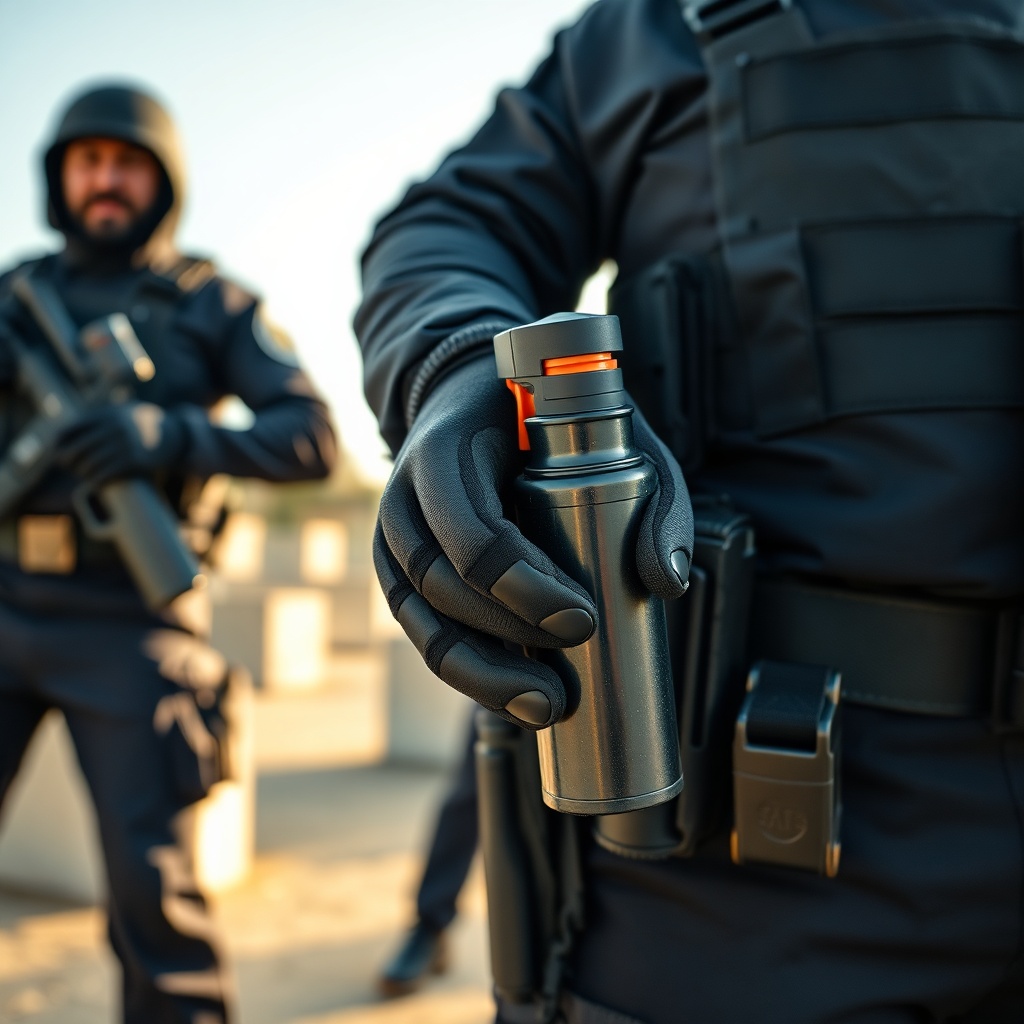
A professional security officer demonstrating proper use of a uniform pepper spray canister during team training.
The Core Criteria for Bulk Selection
The best pepper spray for bulk orders is determined by four core criteria:
- Legal compliance: The product must be legal to possess, carry, and use in every jurisdiction where your personnel operate.
- Formulation consistency: The active ingredient percentage and spray pattern must be identical from batch to batch.
- Supplier reliability: The manufacturer must have a track record of on-time delivery and the capacity to meet your order volume.
- Total cost of ownership: The price must account for shipping, storage, training, and waste, not just the sticker price per canister.
The Shortlist: What the Best Bulk Pepper Spray Looks Like
A professional-grade OC (oleoresin capsicum) spray is the standard choice for bulk procurement. These products are designed for continuous duty and typically feature a higher OC percentage than consumer-grade options. You should look for standardized canister sizes that fit existing holsters and mounting systems, and suppliers who offer tiered pricing, dedicated account management, and custom labeling options for resellers or corporate branding.
Quick Answer: The best pepper spray for bulk orders is a professional-grade OC-based product from a manufacturer that can provide consistent batch quality, legal compliance documentation, and reliable delivery, even if it costs slightly more per unit than a consumer-grade alternative.
The Legal and Regulatory Landscape: What You Must Verify Before Ordering
The legal status of pepper spray varies significantly across states, counties, and municipalities. A product that is perfectly legal in one state may be prohibited or restricted in another. The purchaser bears the responsibility for verifying legality in every location where the product will be carried, stored, or deployed.
Jurisdiction-Specific Restrictions
Before you even begin evaluating formulations, you must map out the legal requirements for your specific operational areas. Some jurisdictions restrict the maximum OC percentage, while others may prohibit certain canister sizes or the use of UV dye. For a business operating across state lines, this is a critical compliance step. The "best" product for a single-state operation might be entirely unsuitable for a national one.
Compliance Documentation and Certifications
A reputable supplier should provide documentation that substantiates their claims. This includes Safety Data Sheets (SDS), which contain detailed information about the chemical composition and handling procedures. You should also request batch test results that verify the heat rating and pressure consistency. Be wary of suppliers who cannot provide third-party testing data to back up their claims.
Labeling and Packaging Requirements
Bulk packaging often differs significantly from retail packaging in terms of compliance requirements. Retail products must have warning labels, ingredient disclosures, and safety information visible to the end consumer. If you are a reseller, you must ensure your custom labeling meets these requirements. For organizational use, the labeling may need to include specific training information or inventory codes for your internal systems.
Evaluating Formulations: The Chemistry That Matters for Bulk Buyers
The active ingredient in pepper spray determines its effectiveness and its legal classification. Understanding the chemistry is essential for making an informed bulk purchase.
OC, CS, and CN: Understanding the Active Ingredients
There are three primary chemical agents used in self-defense sprays: oleoresin capsicum (OC), tear gas (CS), and chloroacetophenone (CN).
Definition: Oleoresin capsicum (OC) is a natural pepper derivative that causes inflammation of the mucous membranes, leading to temporary blindness and a burning sensation. It is the industry standard for personal defense and law enforcement.
OC-based products are the preferred choice for bulk procurement because they are highly effective, non-toxic, and fast-acting. CS and CN are synthetic chemicals that are primarily used for riot control and have more legal restrictions and potential for harm.
The Impact of Formulation on Performance and Liability
The heat rating of OC is measured in Scoville Heat Units (SHU), and the concentration is measured as a percentage. A higher SHU and OC percentage generally mean a more potent product. However, a stronger formulation also carries a higher potential for legal liability and requires more thorough training. For a bulk order, consistency across batches is more important than having the absolute highest heat rating.
Comparing the Common Formulations
| Formulation Type | Primary Active Agent | Typical Use Case | Key Advantage | Key Disadvantage |
|---|---|---|---|---|
| OC (Oleoresin Capsicum) | Natural pepper derivative | Law enforcement, civilian defense | Highly effective, non-toxic, fast-acting | Requires accurate OC percentage verification |
| CS (Tear Gas) | Synthetic chemical | Riot control, military | Strong irritant effect | Not suitable for indoor use; more legal restrictions |
| CN (Chloroacetophenone) | Synthetic chemical | Historical law enforcement | Less effective than OC | Slower onset, higher toxicity concerns |
| OC/CS Blend | Combination | Specialized law enforcement | Broad-spectrum effectiveness | More complex legal and training considerations |
Bulk Pricing Structures and Total Cost of Ownership
The price per unit decreases as order volume increases, but the lowest unit price is rarely the best overall value. You must calculate the total cost of ownership to find the true "best" price.
Understanding the Price Tiers
Wholesale pricing is different from distributor pricing. Wholesale pricing typically applies to orders placed directly with the manufacturer, while distributor pricing applies to orders placed with a middleman. You will usually see price breaks at standard intervals, such as 24, 48, 100, or 500 units. The discount percentage increases with volume, but you must also consider the minimum order quantity (MOQ) required to unlock a specific price tier.
Hidden Costs That Affect the Real Price per Unit
Several hidden costs can dramatically increase the real price per unit:
- Shipping and freight: Large orders of heavy canisters are expensive to ship, especially if you need expedited delivery.
- Storage: Pepper spray should be stored in a cool, dry place, away from direct sunlight and extreme temperatures. This may require dedicated, climate-controlled storage space.
- Training: Switching to a new product line requires retraining your personnel, which has a cost in time and resources.
- Waste: Expired or damaged inventory represents a direct financial loss.
A Step-by-Step Guide to Calculating True Bulk Cost
To compare quotes accurately, follow this process:
- Determine your actual annual usage rate based on historical consumption and projected growth.
- Identify the minimum order quantity (MOQ) for each potential supplier.
- Request quotes for multiple order volumes (e.g., 50, 100, 250, 500 units).
- Calculate the total landed cost per unit by adding shipping, handling, and any applicable taxes or duties.
- Factor in the estimated shelf-life loss percentage based on your storage conditions and consumption rate.
- Compare the total landed cost against the projected value of reduced training time and increased reliability.
Supplier Selection and Quality Assurance Protocols
Selecting a supplier is a long-term strategic decision, not a one-time transaction. You must vet the supplier beyond the price sheet.
Vetting the Supplier: Beyond the Price Sheet
You should verify the manufacturer's history, certifications, and production capabilities. A track record of on-time delivery and order accuracy is paramount. Before committing to a large order, request and review product samples. This allows you to test the spray pattern, the trigger mechanism, and the overall build quality firsthand.
Quality Assurance and Batch Consistency
For professional use, batch-to-batch consistency is critical. Your personnel must be able to rely on the same performance from every canister. A reputable manufacturer should provide testing data that verifies the heat rating, pressure testing, and leak testing for each batch. Independent third-party testing is the most reliable way to verify these claims.
Establishing a Long-Term Supply Agreement
Negotiate terms for price locks, delivery schedules, and minimum order commitments. A clear returns policy for defective or expired products is essential. Your contract should also include clauses that protect your organization in case of supply chain disruptions, such as guaranteed lead times or alternative sourcing options.
Quick Answer: For bulk procurement, you should always request samples and third-party test data from a supplier before committing to a full order. This allows you to verify the product's performance and quality assurance claims with your own team.
Practical Considerations: Storage, Training, and Deployment for Bulk Users
The final factors in your decision are practical: how you will store, train with, and deploy the product.
Storage and Shelf-Life Management
Most professional-grade pepper sprays have a shelf life of 3 to 5 years from the date of manufacture, provided they are stored in a cool, dry place away from direct sunlight and extreme temperatures. You must implement a stock rotation system to ensure the oldest inventory is used first. Expired or damaged units should be disposed of properly according to local regulations.
Training Implications of a Standardized Product
Using a single, consistent product simplifies training and reduces liability. Your training program must cover the specific spray pattern, range, and deployment method of your chosen product. Integrating these protocols into your existing use-of-force or self-defense training is essential. When your team is confident in the equipment, they will deploy it more effectively in a high-stress situation.
Deployment and Accessibility Considerations
The canister size and shape must match your existing holsters, pouches, and mounting systems. Consistent placement and accessibility for all personnel is critical. A bulk purchasing decision can impact uniform standards and operational consistency, so it is important to choose a product that integrates seamlessly with your current gear.
Frequently Asked Questions (FAQ)
Is it legal to buy pepper spray in bulk for resale?
The legality depends on the jurisdiction where the resale occurs and the specific regulations governing the distribution of self-defense products. You must verify state and local laws, obtain any required licenses, and ensure your product complies with labeling requirements for retail sale.
What is the typical shelf life of pepper spray purchased in bulk?
Most professional-grade pepper sprays have a shelf life of 3 to 5 years from the date of manufacture, provided they are stored correctly. Always check the expiration date on each batch and implement a stock rotation system.
Do I need a special license to purchase pepper spray in large quantities?
In many jurisdictions, purchasing pepper spray for organizational use does not require a special license, but some states may require a permit for the possession or use of certain formulations. Always verify the requirements in your specific location.
What is the difference between law enforcement-grade and civilian-grade pepper spray?
Law enforcement-grade pepper spray typically has a higher OC concentration (often 10-20% or more) and a more consistent spray pattern, while civilian-grade products may have lower concentrations and simpler designs. For bulk orders, professional-grade products are often preferred for their reliability and effectiveness.
Can I get custom branding or labeling on a bulk pepper spray order?
Many manufacturers and distributors offer custom labeling and branding services for bulk orders, which is particularly useful for security companies, corporate facilities, and retail resellers. This service usually requires a minimum order quantity and may involve additional costs for design and setup.
Conclusion
Selecting the best pepper spray for bulk orders requires a structured approach that prioritizes legal compliance, formulation consistency, supplier reliability, and total cost of ownership. The cheapest option is rarely the best when you factor in training costs, potential liability, and the risk of supply chain disruptions.
Your procurement process should include a pilot test phase, a compliance review, and a contract negotiation that includes quality assurance and delivery guarantees. Prioritize a professional-grade OC-based product from a verified manufacturer with a strong track record.
Begin the procurement process by requesting samples and compliance documentation from at least three vetted suppliers. This will give you the data you need to make a final decision that protects your organization and your personnel.