
The demand for personal safety products has grown steadily, creating a significant opportunity for retailers, security firms, and distributors.For B2B buyers, sourcing wholesale self-defense products is not a simple transaction—it is a strategic business decision that requires careful attention to legal compliance, liability management, and target market fit. This guide provides a practical framework for navigating the wholesale self-defense market, from supplier vetting to pricing strategy.
Quick Answer: Wholesale self-defense products are personal safety devices—such as pepper spray, stun guns, and personal alarms—purchased in bulk at discounted rates from a distributor or manufacturer for resale to consumers or other businesses.
Key Takeaways
- Wholesale purchasing is a strategic business decision that hinges on legal compliance, liability management, and target market fit, not just price.
- The "best" product line is a function of your sales channel and end-user; a mix of less-lethal and passive defense items usually offers the widest market appeal.
- Vetting a supplier requires more than checking a price list: verifying legal sourcing, insurance, and product certifications is non-negotiable.
- A clear understanding of federal, state, and local regulations is the foundation of a sustainable wholesale business in this sector.
- Building a successful wholesale strategy involves navigating a complex supply chain and implementing smart inventory and marketing tactics.
The Complete Answer: What Are "Wholesale Self-Defense Products"?

A warehouse scene showing a quality control check of wholesale self-defense products, highlighting the business and compliance aspect.
Definition and Scope
Self-defense products encompass a wide range of devices designed to help individuals protect themselves from physical harm. The category includes chemical agents like pepper spray, electroshock devices such as stun guns, impact tools like tactical pens, and passive devices including personal alarms and keychain lights.
Definition: Wholesale refers to the sale of goods in large quantities at reduced prices, typically to businesses rather than individual consumers. Wholesale transactions involve minimum order quantities (MOQs) and are conducted through business-to-business (B2B) channels.
The legal classification of these items varies significantly by jurisdiction. What is legal to sell in one state may be restricted or prohibited in another, which makes understanding the regulatory landscape a foundational step for any wholesale buyer.
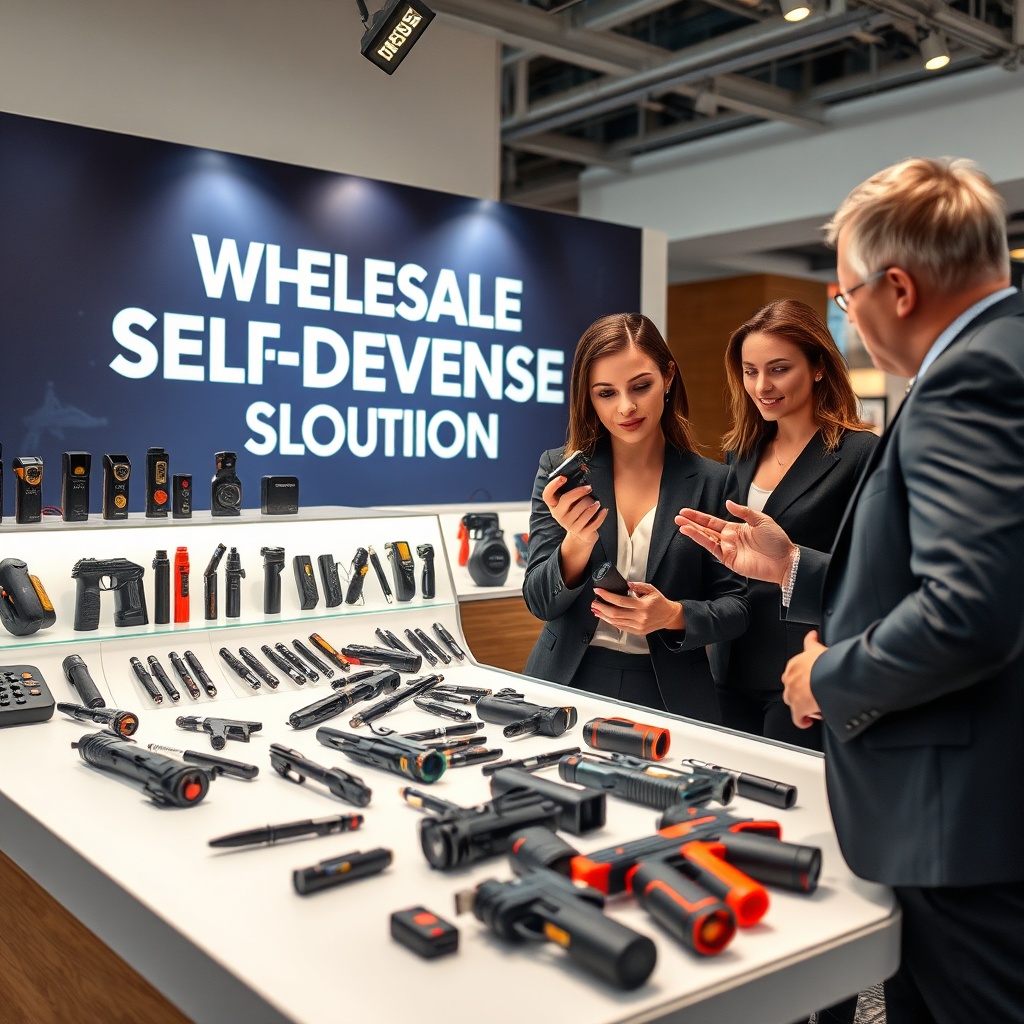
A trade show booth where a buyer evaluates different wholesale self-defense products, emphasizing the strategic selection process.
The Core Product Categories
Less-Lethal Chemical Agents: Pepper spray and OC (oleoresin capsicum) spray are among the most popular self-defense products. They are compact, easy to use, and effective at stopping an attacker temporarily. Tear gas products fall into this category as well, though they are less commonly sold to consumers.
Electroshock Devices: Stun guns deliver an electric shock through direct contact, while tasers use a projectile system to deliver the charge from a distance. The legal distinction between the two is important—tasers are often regulated more strictly and may require additional permits.
Impact and Tactical Tools: Kubotans, tactical pens, and expandable batons are classified as impact tools. They are often marketed as everyday carry (EDC) items because they are discreet and serve practical functions beyond self-defense.
Passive and Alert Devices: Personal safety alarms, keychain lights, and door or window security products are non-violent deterrents. They are widely legal, inexpensive to produce, and appeal to a broad consumer base including students, elderly individuals, and commuters.
Who Buys Wholesale and Why
The primary buyers of wholesale self-defense products include retail stores—such as sporting goods shops, convenience stores, and gift shops—as well as security companies, corporate HR departments implementing employee safety programs, and self-defense instructors who sell products to their students.
The economic rationale for buying wholesale is straightforward: bulk purchasing allows for higher profit margins, the ability to offer a complete safety solution to customers, and the potential for recurring demand from repeat buyers. For a self-defense products distributor, a well-curated product line can become a steady revenue stream with strong customer loyalty.
The Wholesale Buyer's Journey: From Market Analysis to Business Strategy
Assessing Your Target Market and Sales Channel
Before sourcing any products, define your end-user. Are you selling to individual consumers, corporate clients, or other businesses? The product mix and marketing strategy will differ drastically depending on the answer.
A retailer serving college students might focus on personal alarms and compact pepper spray, while a security equipment supplier targeting corporate clients would prioritize higher-end stun guns and tactical gear. Understanding your competitive landscape—who is already serving your niche and how you can differentiate—is equally critical.
Sourcing and Vetting Wholesale Suppliers
Quick Answer: To vet a self-defense supplier, request product documentation, verify legal compliance, check for product liability insurance, order samples, and review their return policies. Avoid suppliers with unrealistically low prices or poor communication.
The vetting process is the most important step in building a reliable supply chain. Follow this step-by-step guide:
- Initial Research: Identify potential suppliers through trade shows, industry directories, and online B2B marketplaces.
- Request a Product Catalog and Price List: Evaluate the breadth of their product line and the wholesale pricing structure.
- Verify Legal Compliance: Request documentation confirming they are sourcing and selling products that meet regulatory standards. For pepper spray, check for EPA or FDA compliance; for stun guns, verify they comply with state laws.
- Check for Insurance and Liability Coverage: Confirm the supplier has product liability insurance to protect your business.
- Order Samples: Test the quality, reliability, and functionality of the products yourself before committing to a bulk order.
- Review Customer Service and Return Policies: Assess their responsiveness and their policies for defective products.
Key Supplier Red Flags: Unrealistically low prices, lack of product documentation, and poor communication are all warning signs. A reputable self-defense weapons supplier will be transparent about their sourcing and compliance practices.
Navigating Legal and Regulatory Compliance
The legal landscape for self-defense products is complex and varies by state and local jurisdiction. Laws govern who can sell these items, who can purchase them, and in some cases, the size or concentration of the products themselves.
Liability management is equally important. Proper product labeling, age restrictions, and clear disclaimers for the end-user are essential to protect your business. If you are importing or exporting products, you must also understand the customs regulations and import restrictions that apply to your region.
Strategic Product Selection and Pricing for Profitability
Building a Profitable Product Portfolio
A successful product portfolio balances high-volume items with high-margin products. Personal alarms, for example, are inexpensive to produce and attract price-sensitive customers, while high-end stun guns generate higher profit per unit.
The "safety kit" model is a proven strategy for increasing average order value. By bundling complementary items—such as pepper spray, a keychain alarm, and a tactical pen—you provide a comprehensive solution while increasing the total sale amount.
Wholesale Pricing Strategies and MOQs
Minimum order quantities (MOQs) are the minimum number of units a supplier requires you to purchase in a single order. MOQs can range from a small number of units to a full case or pallet, depending on the product and supplier. Negotiating favorable MOQs can significantly impact your cash flow and inventory management.
When setting your retail pricing, calculate your margins carefully. Factor in the wholesale cost, shipping, and any overhead, then determine a retail price that is competitive yet profitable. A common framework is to aim for a 50-100% markup, though this varies by product category and market.
Comparison Table: Product Categories for Wholesale Buyers
| Product Category | Typical End-User | Selling Point | Potential Legal Restrictions |
|---|---|---|---|
| Pepper Spray | General public, women, runners | Effective, easy to use, portable | Restricted in some states (e.g., size, concentration) |
| Stun Guns | Security guards, high-risk individuals | Long-range stopping power, non-lethal | Illegal in some states (e.g., MA, HI, NY) |
| Personal Alarms | Students, elderly, commuters | Deterrent, non-violent, widely legal | Minimal to none |
| Tactical Tools (e.g., Pens) | Professionals, everyday carry (EDC) users | Discreet, practical, multi-functional | Generally legal, but check for "weapon" classifications |
Marketing and Selling Wholesale Self-Defense Products Effectively
Content and Education as a Marketing Strategy
Educational content is one of the most effective marketing tools in this industry. Providing free information on personal safety and product usage builds trust with your audience and positions you as an authority. Create targeted content for specific niches—college safety guides, urban commuter tips, or senior citizen safety checklists—to reach the right customers with the right message.
Building a Successful B2B Sales Funnel
Outreach to Retailers: Approach potential retail partners by presenting your product line as a profitable addition to their store. Provide them with clear margin calculations and marketing support to make the decision easy.
Direct-to-Consumer (D2C) Wholesale: If you sell directly to end-users, consider offering a "buy in bulk" option on your e-commerce site. This allows customers to purchase larger quantities at a discounted rate, increasing your average order value.
Managing Inventory and Logistics
A reliable supply chain is critical to maintaining adequate stock levels without over-investing in inventory. Monitor sales trends and adjust your orders accordingly. For fulfillment, be aware that some products may have specific handling or shipping requirements due to their classification as hazardous materials or regulated devices.
Frequently Asked Questions (FAQ)
Are wholesale self-defense products legal to sell?
Legality varies by jurisdiction. The onus is on the wholesaler and retailer to understand and comply with local laws. Some products are legal nationwide, while others are restricted or prohibited in specific states and municipalities.
What is the typical minimum order quantity (MOQ) for self-defense products?
MOQs are set by the supplier and can range from a small number of units to a full case or pallet. The MOQ depends on the product category, the supplier's production capacity, and the wholesale pricing structure.
How do I find a reputable wholesale supplier for self-defense products?
Start by researching suppliers through trade shows, industry directories, and B2B marketplaces. Then verify their legal compliance, request product documentation, check for liability insurance, and order samples before committing to a bulk order.
What is the profit margin on wholesale self-defense products?
Margins vary widely based on the product category, supplier pricing, and your retail strategy. However, the potential for significant margins is one of the primary reasons this market attracts B2B buyers.
Do I need a business license to buy self-defense products at wholesale prices?
Yes, a valid business license and often a resale certificate are typically required to purchase products at wholesale rates. Suppliers use these documents to verify that you are a legitimate business.
Conclusion
Success in the wholesale self-defense market is built on three pillars: a deep understanding of the legal landscape, a rigorous supplier vetting process, and a well-defined target market. Price alone should never be the deciding factor when choosing a supplier or a product line.
Start by defining your niche and conducting thorough legal research for your specific region. Then, vet potential suppliers carefully, order samples, and build a product portfolio that meets the needs of your target customers. With the right foundation, this market offers a sustainable and profitable business opportunity.